

Smart Money Concepts (SMC)
Think like institutions, not like the crowd
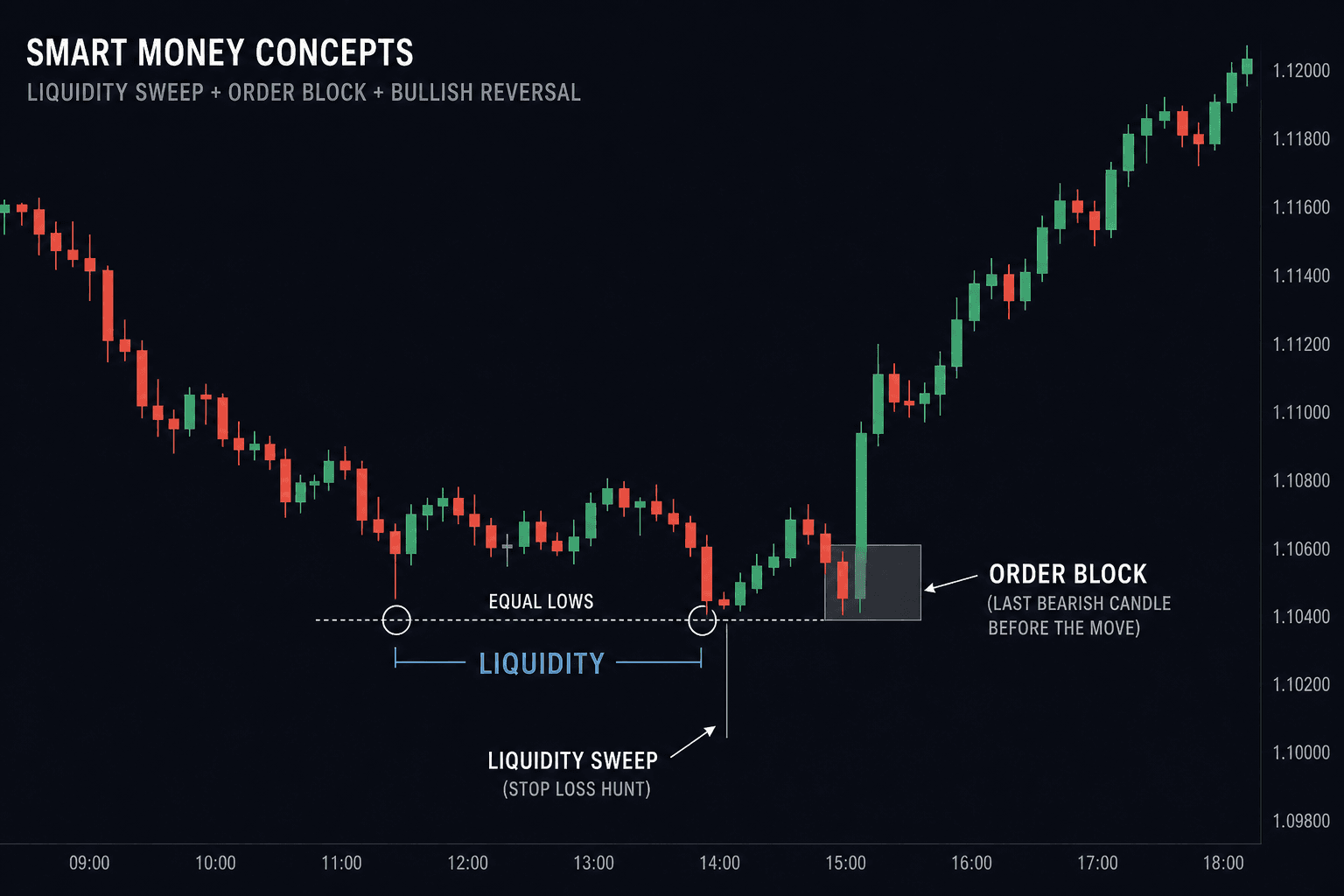
The school that exploded in popularity in recent years. Its core idea is that the market does not move randomly. Banks and large institutions (the smart money) move it, and the retail trader's job is to read their footprints and follow, instead of standing in their way.
It works with concepts like liquidity pools (where everyone's stop losses cluster), order blocks (the last accumulation zone before a strong move), and fair value gaps. The idea is that price returns to these areas to collect liquidity before continuing in the real direction.
The picture sums up a scene we see a lot: the market prints equal lows, people park stops under them because the textbook said so. Then a long wick dips under those lows, grabs the stops, and rips back up. The person who shorted the break got hurt. The person who waited for the sweep and the reclaim read the game.
An order block is not a magic rectangle either. It is usually the last opposing candle before the impulsive move. Price often comes back to tap it as a supply or demand area, and that is when you look for confirmation: a rejection candle, a filled gap, a shift in structure.
Let's be honest: some people have turned this into a religion and talk about it like a sacred secret. At the end of the day it is an organized way to read market structure and liquidity. Genuinely powerful once you get it right, but not a magic wand and never a substitute for money management. If you have no stop, SMC will not save you.
Key concepts
- Liquidity and stop-loss clusters
- Order blocks
- Fair value gaps (FVG)
- Break of structure (BOS) and change of character (CHoCH)
Who is it for?
For traders who are past the basics and want to understand what happens behind the scenes of a price move.