

The Wyckoff Method
What is the big player doing before the move?
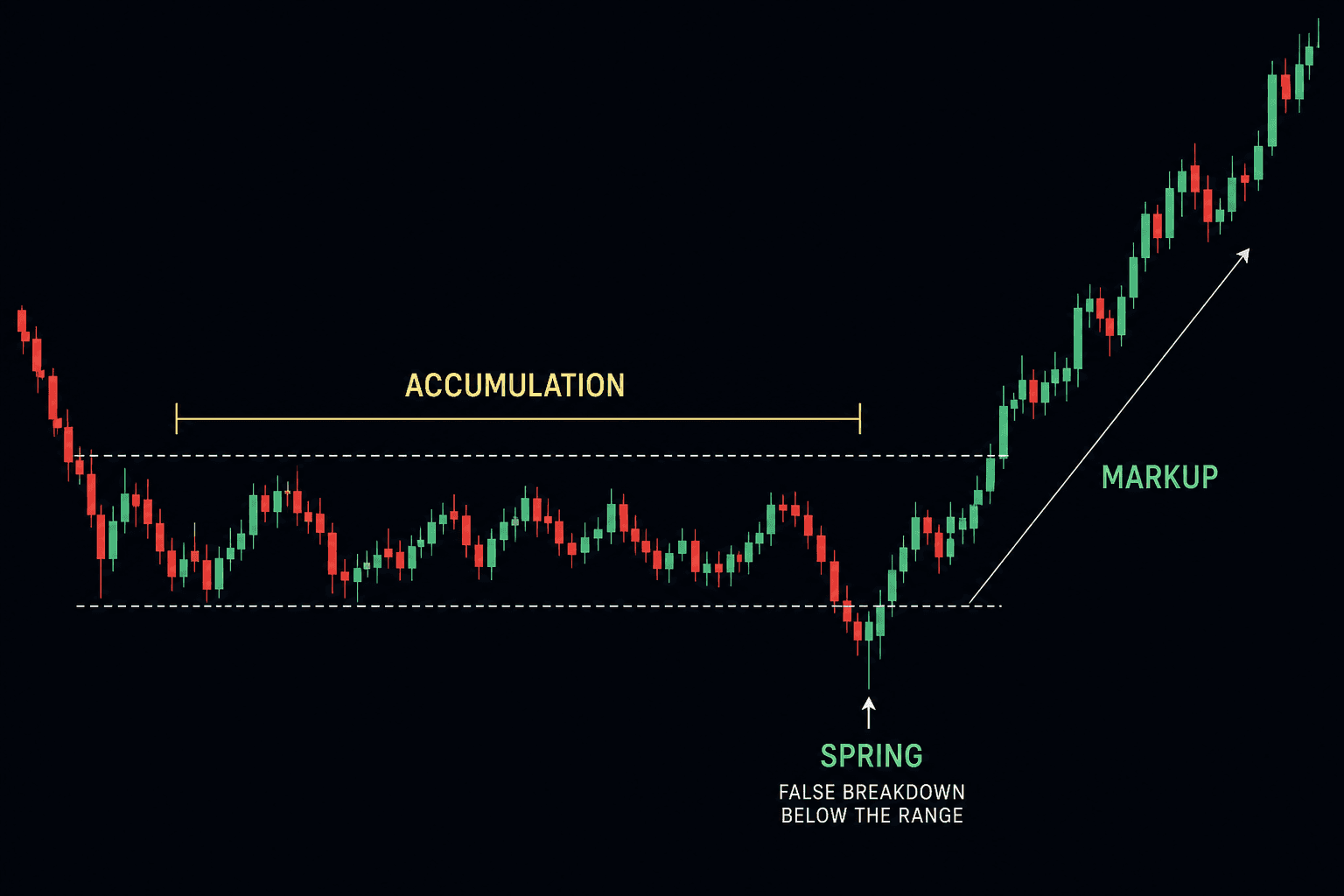
Richard Wyckoff was one of the first to talk about the Composite Man: imagining the whole market as one big player who quietly accumulates, then marks price up, or quietly distributes, then marks it down. Every modern smart-money concept has its roots here.
The method divides market movement into phases: accumulation, markup, distribution, markdown. Inside the accumulation and distribution ranges there are known events like the Spring: the fake break below support that traps sellers right before the launch.
You can read the phase on the picture. Price is stuck in a range, people get bored, then a break under the range grabs stops (the Spring), then it snaps back inside quickly. That reclaim is the tell that the break was a trap, not a new downtrend. The people who sold the break become fuel for the rally.
Its biggest addition compared to other schools is volume. The relationship between price movement and traded volume is the heart of the method. A strong move on weak volume is a warning sign. A breakout on huge volume means something completely different. Retail forex volume is not as clean as stocks, so Wyckoff shines more on stocks and crypto, but the phase idea still helps in any market.
If you want it practical: decide if the market is ranging or trending. If it is ranging, ask whether accumulation is happening below or distribution above. Do not buy every break. Wait for the snap-back into the range after the sweep. That one sentence will save you a lot of dumb trades.
Key concepts
- The four market phases (accumulation, markup, distribution, markdown)
- The Composite Man
- Springs and upthrusts
- Price and volume relationship analysis
Who is it for?
For those who want to understand market logic from its roots, especially stock and crypto traders, where volume data is real.